Every day in my physical therapy practice, I work with people who are in pain — and naturally, they ask a common and important question:
“Am I making this worse?”
Today, I want to share a simple but powerful tool that can help you answer that question on your own — especially if you’re trying out exercises or stretches as part of your recovery.
Pain Is Complicated — But Not Always a Danger Sign
Before we dive in, let’s talk about pain for a second.
Pain is a universal experience, but it’s also deeply personal. One widely accepted definition is that pain is a negative sensory experience created by your nervous system when it thinks your body is in danger.
But is pain always a sign of damage? Absolutely not. Pain can be triggered by many things — stress, poor sleep, anxiety, previous injuries, and yes, mechanical irritation. The bottom line is this: pain is not always an accurate reflection of harm.
This is where the right framework can make a big difference.
Enter the Traffic Light Guide
One of my professional heroes, a New Zealand physiotherapist named Robin McKenzie, created a simple but brilliant system called the Traffic Light Guide. It’s designed to help people make sense of how movement affects “mechanical pain” — the kind that comes from muscles, joints, or other soft tissues.
When used properly, the guide helps you:
- Understand whether a movement is helping or hurting
- Feel more in control of your recovery
- Make smart choices about which exercises to keep doing (or avoid)
Here’s how it works:
Step 1: Establish Your Baseline
Before you do anything, take a moment to tune in.
- Where is the pain located?
- How intense is it?
- Are you stiff, tight, or limited in any movements?
This becomes your baseline, or your starting point. Knowing how you feel beforehand is essential to understanding what changes after activity.
Step 2: Try the Movement or Activity
Now, perform the exercise or movement in question. This could be a prescribed stretch, a self-guided activity, or even something as simple as standing up from a chair.
Step 3: Reflect — What Color Was the Light?
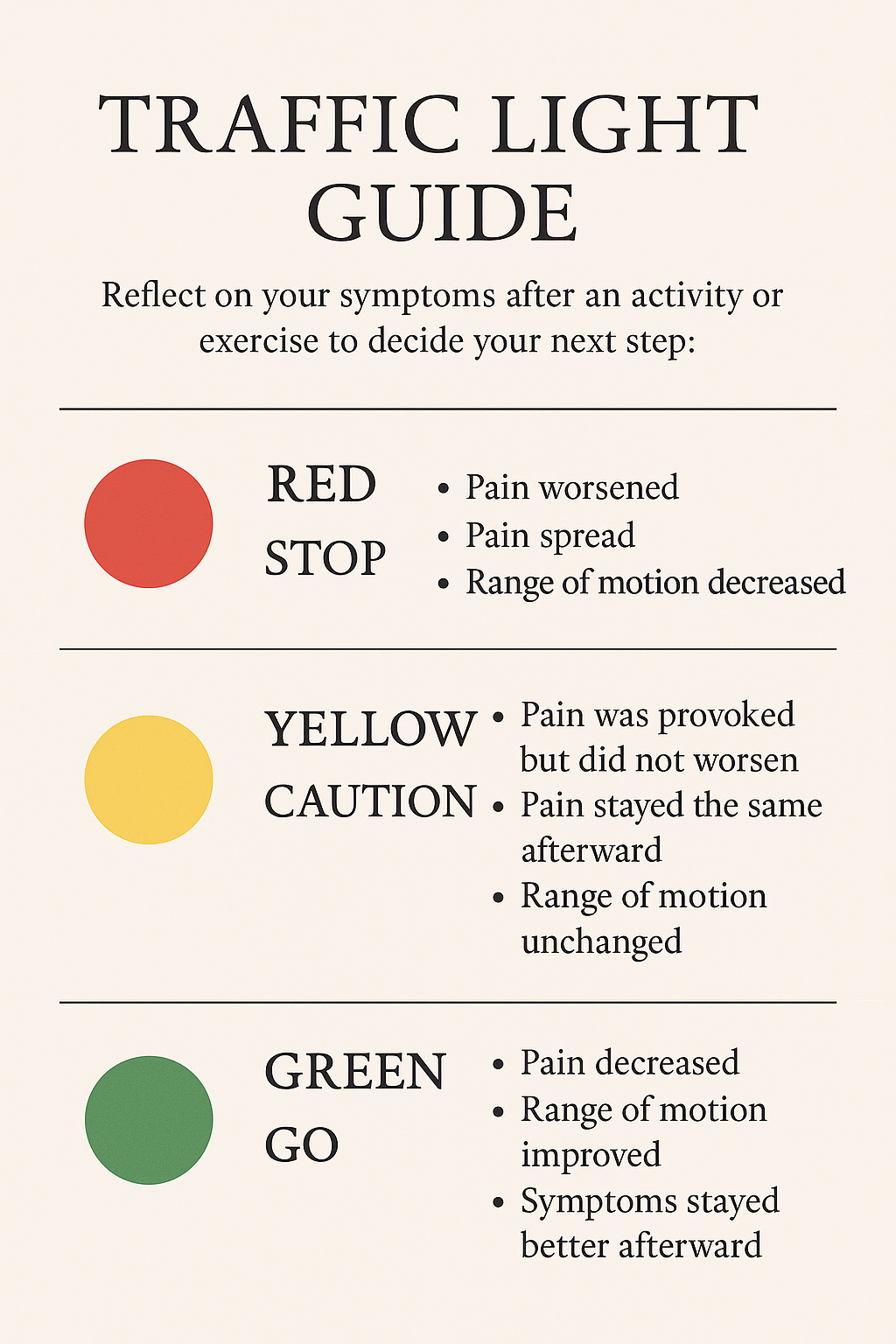
Now that you’ve tried the movement, it’s time to interpret the results using the Traffic Light system:
🔴 Red Light = Stop
- The pain got worse as you moved
- The pain spread to a wider area
- Your range of motion decreased
- You continued to feel worse after the activity
This movement is not safe right now. Avoid it until a healthcare provider can modify it for you or until your symptoms calm down.
🟡 Yellow Light = Caution
- The movement hurt, but the pain didn’t worsen overall
- Pain stayed the same afterward
- Your range of motion did not improve or worsen
This is neutral ground. You’re likely not harming yourself, but you may need to proceed more gently — or with guidance from a professional.
🟢 Green Light = Go
- Pain decreased during or after the movement
- Your range of motion improved
- You felt better than your baseline
This movement is likely therapeutic. It’s helping calm the nervous system, improve mobility, and promote healing. It’s probably a keeper in your recovery plan.

Why This Matters
At first glance, this system seems simple — and that’s the beauty of it. But when you’re in pain, your nervous system is on high alert, and everything can feel threatening. The Traffic Light Guide helps remove some of the guesswork and gives you a sense of control.
Still, it’s not always easy to judge for yourself. That’s where a skilled physical therapist can be incredibly valuable — helping you fine-tune your movement, read your body’s signals more accurately, and design a plan that works with your nervous system, not against it.
Final Thoughts
If you’re dealing with injury-related pain and find yourself asking, “Is this making it worse?” — try the Traffic Light method. It’s a small step that can provide big insights.
And remember, while tools like this are helpful, they’re not a substitute for individualized care. If your pain persists or you’re unsure about next steps, don’t hesitate to reach out for professional support.
Get Expert Help, Right at Home
I offer concierge physical therapy across Southeastern Massachusetts — one-on-one, in-home care that gives you the time, attention, and results you deserve. Let’s get you back to doing what you love, without the guesswork.