Reclaim Your Active Lifestyle

Is pain holding you back from enjoying life?

Blog

  • Parkinson’s Disease Explained Simply: What’s Happening in the Brain and How In-Home LSVT-BIG Therapy in Southeastern Massachusetts Can Help You Fight Back

    There are few things as frightening as a serious health diagnosis — especially one that changes how you move, speak, and live every day. Whether it’s happening to you or someone you love, the questions hit hard: What is this? Will I lose my independence? How will this affect my family? Can I still do the things that matter most to me?

    I hear these questions every week. And I want you to know: you are not alone, and there is real hope.

    I’m a physical therapist who specializes in Parkinson’s disease and I’m certified in the LSVT BIG program. Because I come directly to your home, I remove every barrier so you can get the high-intensity, high-frequency care that actually moves the needle. I serve southeastern Massachusetts — from Milton in the north to Duxbury in the south, and everywhere in between.

    Knowledge truly is power. Understanding what Parkinson’s is and why certain treatments work can replace fear with focus and turn “I don’t know what to do” into “Here’s exactly what I can do.”

    What Does Parkinson’s Disease Actually Look Like?

    Parkinson’s is a movement disorder caused by a drop in the chemical messenger dopamine in a key part of the brain. The result is a sensory-motor mismatch: your brain thinks you’re moving with normal size and speed, but in reality your movements become smaller, slower, and less powerful than you intend.

    You might notice:

    • Smaller steps and shuffling gait
    • Quieter voice and softer speech
    • Difficulty swallowing
    • Less facial expression (sometimes called a “masked” or flat face)
    • Stiffness (rigidity) or tremor
    • Fatigue, trouble with balance, and slower everyday tasks

    Non-motor symptoms often appear too — low mood, sleep changes, cognitive fog, or constipation — because dopamine affects far more than just movement.

    The good news? The disease usually starts mildly and on one side, giving us a valuable window to act early and powerfully.

    What’s Happening Inside the Brain? (The Faucet Analogy)

    Imagine your brain wants to send a “move” signal to your body. That signal has to pass through a relay station called the thalamus — think of it as a faucet that controls how much movement gets through.

    In a healthy brain, a circuit called the basal ganglia uses dopamine to keep that faucet open just the right amount so movements are big, smooth, and automatic.

    In Parkinson’s, dopamine production drops. The faucet slowly closes. Movements shrink. That shrinkage is called bradykinesia — the hallmark of the disease.

    How Is Parkinson’s Treated?

    Most medical treatments focus on restoring dopamine levels so the faucet can open again:

    Medications like Sinemet

    In some cases, Deep Brain Stimulation (DBS)

    These are incredibly helpful, but they are mostly passive — you take a pill or have a procedure done to you.

    The Power You Hold: Intense, Amplitude-Focused Exercise

    Here’s where you become the hero of your own story.

    Research now shows that high-intensity exercise focused on large-amplitude movements can actually help the brain increase dopamine availability and recalibrate your movement sense. In other words, you can attack the problem from the other side of the faucet.

    There are several effective programs (including non-contact boxing and dynamic balance training), but the one I’m specially trained and certified in is LSVT BIG.

    LSVT BIG is not ordinary physical therapy. It is a research-backed, high-intensity protocol that retrains your brain through BIG, effortful movements. Patients often tell me the first few sessions feel “ridiculously big” — and that’s exactly the point. What feels exaggerated to you actually looks normal to everyone else.

    With consistent practice, two powerful things happen:

    1. Your brain recalibrates so big movements start to feel normal again.
    2. The intense exercise itself drives increased dopamine production — literally loosening the faucet from the inside.

    Many of my patients notice they can reduce medication doses or rely on them less often, move more confidently, speak louder, and reclaim activities they thought were gone.

    You Don’t Have to Fight This Alone — And You Don’t Have to Leave Home

    Because I bring LSVT BIG and personalized Parkinson’s physical therapy directly into your living room, you get the frequency and intensity you need without exhaustion, transportation stress, or waiting-room fatigue. Whether you’re in Milton, Duxbury, Plymouth, Brockton, or any community in between, help is literally at your doorstep.

    Parkinson’s is a battle, but it is a battle you can fight — and win ground in — every single day.

    If you or someone you love has been diagnosed with Parkinson’s disease, I want you to feel hope instead of helplessness.

    Click the Contact button at the top of this page right now and schedule your free 20-minute phone consultation with me. We’ll talk about where you are, what you’re struggling with, and how in-home LSVT BIG therapy can help you move better, feel stronger, and live more fully — right in the comfort of your own home.

    You’ve already taken the first step by reading this far.

    The next step is simple, and I’m right here with you.

    Let’s get started.
  • Understanding Vestibular Disorders: How Physical Therapy Can Help

    Understanding Vestibular Disorders: How Physical Therapy Can Help

    When most people think of physical therapy, they usually picture someone recovering from back pain, a sprained muscle, or surgery. While these are all common reasons to see a physical therapist, there’s another important area of care that’s often overlooked: vestibular disorders.

    What Are Vestibular Disorders?

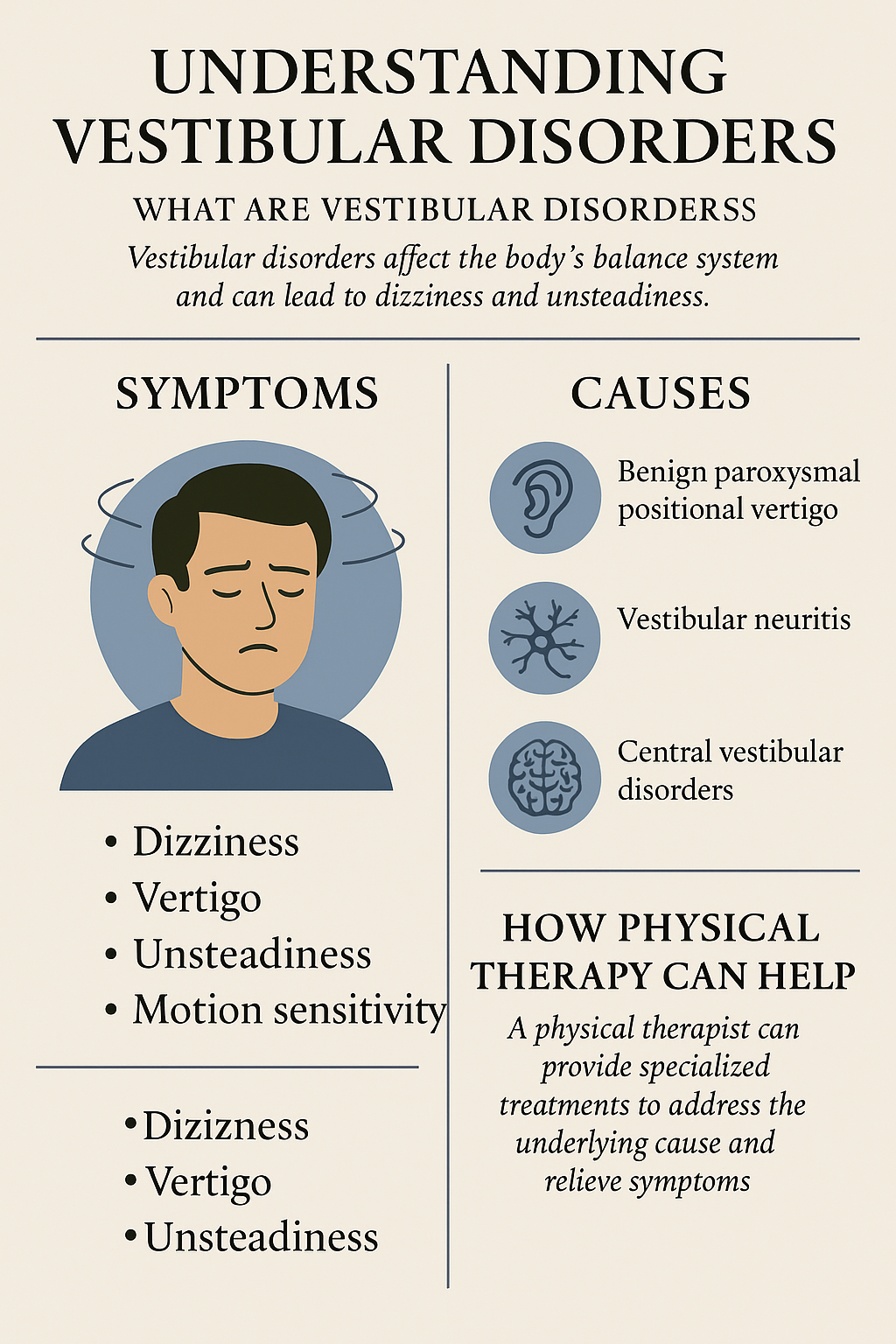
    Vestibular disorders affect the body’s balance and equilibrium system—the system that helps us move safely through the world on two feet. Under normal circumstances, we take balance for granted. That’s because our brains constantly integrate information from:

    • Our vision
    • Our sense of body awareness (proprioception)
    • Our inner ear organs (the vestibular system)

    These systems work together behind the scenes to keep us steady, upright, and oriented in space. But when something goes wrong in this delicate system, it can cause serious problems.

    Symptoms of Vestibular Dysfunction

    People with vestibular disorders often experience:

    • Dizziness
    • Spinning sensations (vertigo)
    • Unsteadiness or imbalance
    • Difficulty focusing during movement
    • Motion sensitivity

    These symptoms can range from mild to debilitating—and when present, they make daily life significantly more difficult.

    What Causes Vestibular Disorders?

    Vestibular disorders can result from various causes, and their complexity can vary widely. Some common examples include:

    • Benign Paroxysmal Positional Vertigo (BPPV): A mechanical issue in the small, fluid-filled canals of the inner ear. One of the most common vestibular disorders, often triggered by changes in head position.
    • Vestibular Neuritis or Labyrinthitis: Inflammation of the vestibular nerve, which transmits balance signals from the inner ear to the brain.
    • Central Vestibular Disorders: Involving the parts of the brain that interpret balance signals. These tend to be more complex and may require a neurologic work-up.
    • Non-Vestibular Causes: Dizziness can also stem from issues unrelated to the vestibular system, such as low blood pressure, medication side effects, or cardiovascular issues. A skilled clinician must be able to recognize these red flags and refer appropriately.

    How Physical Therapy Can Help

    With specialized training and equipment, physical therapists can successfully assess and treat many vestibular disorders. However, vestibular rehab is a highly specialized field that requires:

    • Advanced clinical training
    • Careful diagnostic techniques
    • Sophisticated tools

    One of the key tools in vestibular assessment is the use of Frenzel goggles. These goggles allow the therapist to observe the patient’s involuntary eye movements (nystagmus) during specific head and body positions, while also blocking out visual distractions that could suppress these reflexes. This allows for accurate assessment rather than guesswork.

    A good vestibular physical therapy clinic should have both the clinical skills and the equipment to evaluate and treat the root cause of symptoms. If you’re considering care, don’t hesitate to ask a prospective provider if they’re equipped with tools like Frenzel goggles—it’s a great indicator that they take vestibular care seriously.

    The Bottom Line

    Vestibular disorders can be distressing, but they are treatable—especially when the right clinician is involved. A skilled physical therapist trained in vestibular rehab can guide you through the recovery process with targeted exercises and interventions based on an accurate diagnosis.

    If you’re experiencing dizziness, vertigo, or unexplained imbalance, don’t wait. Reach out to a qualified vestibular PT and get the help you need to feel steady again.


    Have questions or wondering if vestibular therapy might help you?

    — we’re happy to talk and help you find clarity.

  • What Your MRI Really Means: Understanding Imaging and Pain

    If you’ve ever had an MRI, CT scan, or X-ray for a musculoskeletal issue, you might have come away with more questions than answers — or worse, some new fears.

    Let’s clear things up.


    We Live in a Medical Marvel — But It Has Its Limits

    We live in an era of incredible medical innovation. Vaccines have changed the course of history. Childbirth is safer than ever. And advanced imaging — like X-ray, CT, ultrasound, and MRI — gives us the power to visualize the inner workings of the human body in exquisite detail.

    From bone spurs to intervertebral disc degeneration, arthritis, labral tears, and meniscus changes, we now have the technology to spot even the most subtle changes in our joints and tissues. That sounds like a win, right?

    Yes — but only if we understand what we’re looking at.


    Normal Aging or Dangerous Diagnosis?

    As imaging became more widespread, the medical field started connecting the dots. “If we see this bulging disc or arthritis on the scan,” we thought, “it must be causing the pain.”

    But the reality? Many of the things we see on imaging are completely normal, age-related changes. For example:

    • By age 30, many people already show signs of osteoarthritis (OA) on MRI.
    • By age 65 or older, studies show that 93% of people have “degenerative disc disease” visible on imaging.

    But here’s the kicker: Most of them don’t have any symptoms.

    So if you hear something scary in your MRI report — like “disc desiccation” or “facet arthropathy” — it might not mean anything dangerous. In fact, it might not be causing your pain at all.


    The Power of Language: Why the Words We Use Matter

    One of the most harmful parts of modern imaging is the language used in radiology reports. Imagine hearing that you have:

    • “Degenerative Disc Disease”
    • “Mild Neural Foraminal Narrowing”
    • “Multilevel Spondylosis”

    It sounds serious. Frightening, even. But the truth is, these are common findings in healthy, pain-free people. Unfortunately, the names we use can make a normal situation feel threatening.

    This is what we call the Nocebo Effect — when negative expectations lead to worse symptoms. It’s the opposite of the placebo effect.

    Even highly trained doctors and clinicians can fall victim to it when reading their own imaging reports. The result? More fear, more disability, and less willingness to move or exercise — which actually makes pain worse in the long run.


    “Gray Hairs on the Inside”

    Pain researchers today often refer to these imaging findings as “gray hairs on the inside.” They’re just the body’s natural signs of wear and tear — not a roadmap to disability.

    To quote a mentor of mine, master clinician Dana Greene from upstate New York:

    “I have wrinkles on my face — that doesn’t mean I have a degenerative face!”

    Exactly.


    When Imaging Is Important

    Let’s be clear: Medical imaging has its place — and an important one. If you or your provider suspect something serious like:

    • A bone fracture
    • Cancer or tumor
    • Infection
    • Spinal cord compression
    • Or symptoms like sudden incontinence, foot drop, or unrelenting night pain

    Then yes — imaging can be lifesaving.

    But for common cases like new-onset back pain, imaging often doesn’t change the course of treatment — and can sometimes do more harm than good, especially early on.


    So, What Should You Do?

    If you’re in pain and unsure about what to do next:

    Don’t panic about your MRI or X-ray report.
    Remember that most findings are normal for your age.
    Avoid jumping to worst-case scenarios.
    Find a skilled, attentive healthcare provider who understands how to interpret imaging in the context of your symptoms and movement.


    Final Thoughts

    You’re not your MRI report.

    You’re a person, with a history, a nervous system, and a life to get back to. While imaging can provide helpful insights, it shouldn’t define your treatment — or your mindset.

    If you’re feeling overwhelmed after reading a scan report or just want someone to guide you through what it all means, I’m here to help.


    Personalized Physical Therapy in Southeastern Massachusetts

    I offer concierge, one-on-one physical therapy delivered right in the comfort of your home. No waiting rooms, no rushed visits — just clear answers, effective care, and a plan tailored to you.

    Let’s figure this out — together.

  • Is This Making It Worse? How to Tell If a Movement Is Helping or Hurting

    Is This Making It Worse? How to Tell If a Movement Is Helping or Hurting

    Every day in my physical therapy practice, I work with people who are in pain — and naturally, they ask a common and important question:

    “Am I making this worse?”

    Today, I want to share a simple but powerful tool that can help you answer that question on your own — especially if you’re trying out exercises or stretches as part of your recovery.


    Pain Is Complicated — But Not Always a Danger Sign

    Before we dive in, let’s talk about pain for a second.

    Pain is a universal experience, but it’s also deeply personal. One widely accepted definition is that pain is a negative sensory experience created by your nervous system when it thinks your body is in danger.

    But is pain always a sign of damage? Absolutely not. Pain can be triggered by many things — stress, poor sleep, anxiety, previous injuries, and yes, mechanical irritation. The bottom line is this: pain is not always an accurate reflection of harm.

    This is where the right framework can make a big difference.


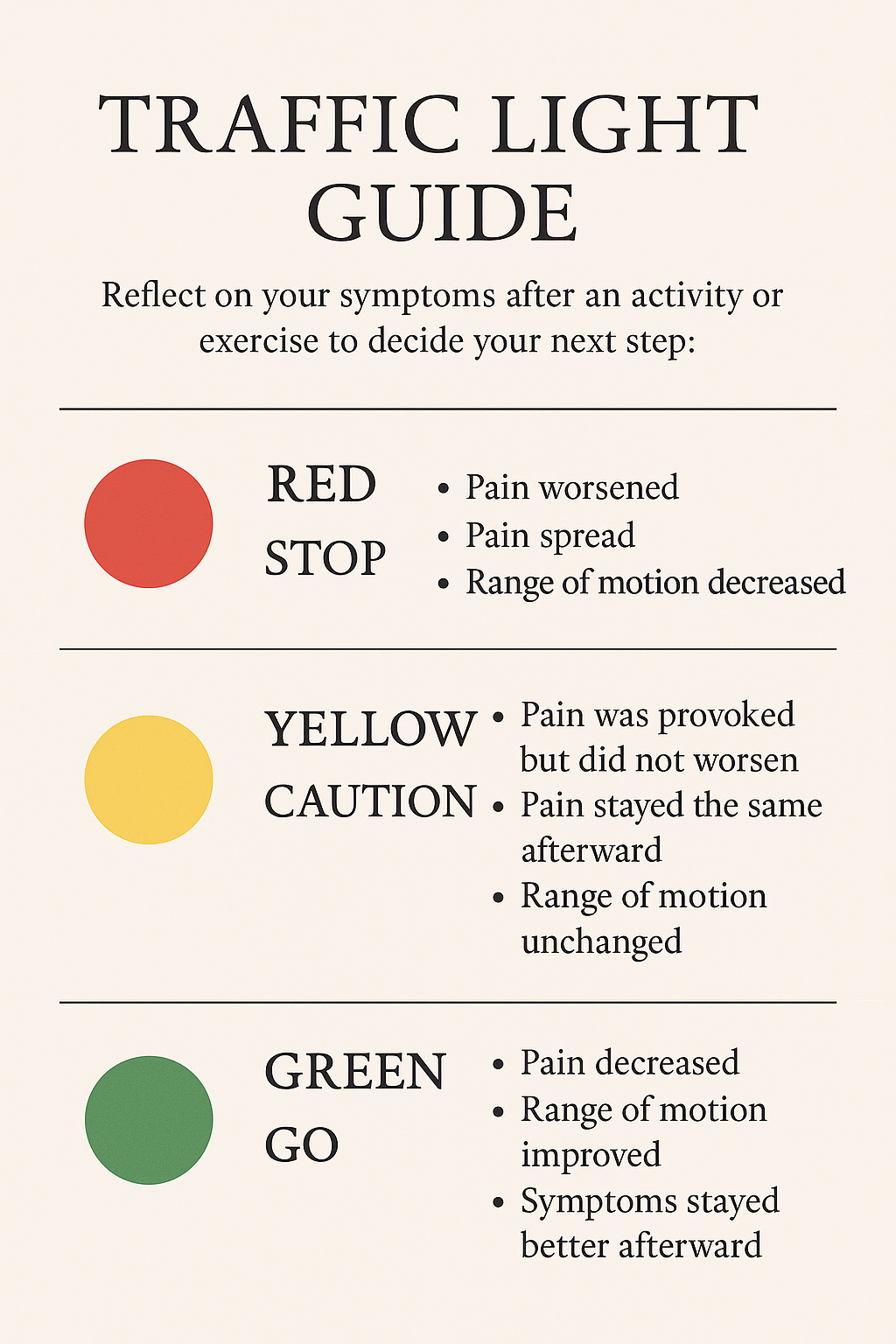
    Enter the Traffic Light Guide

    One of my professional heroes, a New Zealand physiotherapist named Robin McKenzie, created a simple but brilliant system called the Traffic Light Guide. It’s designed to help people make sense of how movement affects “mechanical pain” — the kind that comes from muscles, joints, or other soft tissues.

    When used properly, the guide helps you:

    • Understand whether a movement is helping or hurting
    • Feel more in control of your recovery
    • Make smart choices about which exercises to keep doing (or avoid)

    Here’s how it works:


    Step 1: Establish Your Baseline

    Before you do anything, take a moment to tune in.

    • Where is the pain located?
    • How intense is it?
    • Are you stiff, tight, or limited in any movements?

    This becomes your baseline, or your starting point. Knowing how you feel beforehand is essential to understanding what changes after activity.


    Step 2: Try the Movement or Activity

    Now, perform the exercise or movement in question. This could be a prescribed stretch, a self-guided activity, or even something as simple as standing up from a chair.


    Step 3: Reflect — What Color Was the Light?

    Now that you’ve tried the movement, it’s time to interpret the results using the Traffic Light system:

    🔴 Red Light = Stop

    • The pain got worse as you moved
    • The pain spread to a wider area
    • Your range of motion decreased
    • You continued to feel worse after the activity

    This movement is not safe right now. Avoid it until a healthcare provider can modify it for you or until your symptoms calm down.


    🟡 Yellow Light = Caution

    • The movement hurt, but the pain didn’t worsen overall
    • Pain stayed the same afterward
    • Your range of motion did not improve or worsen

    This is neutral ground. You’re likely not harming yourself, but you may need to proceed more gently — or with guidance from a professional.


    🟢 Green Light = Go

    • Pain decreased during or after the movement
    • Your range of motion improved
    • You felt better than your baseline

    This movement is likely therapeutic. It’s helping calm the nervous system, improve mobility, and promote healing. It’s probably a keeper in your recovery plan.


    Why This Matters

    At first glance, this system seems simple — and that’s the beauty of it. But when you’re in pain, your nervous system is on high alert, and everything can feel threatening. The Traffic Light Guide helps remove some of the guesswork and gives you a sense of control.

    Still, it’s not always easy to judge for yourself. That’s where a skilled physical therapist can be incredibly valuable — helping you fine-tune your movement, read your body’s signals more accurately, and design a plan that works with your nervous system, not against it.


    Final Thoughts

    If you’re dealing with injury-related pain and find yourself asking, “Is this making it worse?” — try the Traffic Light method. It’s a small step that can provide big insights.

    And remember, while tools like this are helpful, they’re not a substitute for individualized care. If your pain persists or you’re unsure about next steps, don’t hesitate to reach out for professional support.


    Get Expert Help, Right at Home

    I offer concierge physical therapy across Southeastern Massachusetts — one-on-one, in-home care that gives you the time, attention, and results you deserve. Let’s get you back to doing what you love, without the guesswork.

  • What Posture Has to Do with Your Pain (And How to Check It Yourself)

    Today I want to offer a helpful perspective on something that comes up a lot in my work with clients dealing with pain: posture.

    But not in the “sit up straight or else” kind of way. Instead, let’s talk about what posture really means, why it matters, and how it might be connected to the pain or discomfort you’re feeling — especially in your back, shoulders, or neck.


    Your Body Is a Machine – A Really Smart One

    Think of your body as a multi-purpose machine — a vehicle that gets you from place to place, helps you work, care for your family, play, train, and do a thousand other things. Just like a machine, your body needs to be able to organize its parts to do a job well. That organization is what we call posture.

    Imagine a crane on a construction site. Before it picks something up, it:

    • Drives into position
    • Locks into place
    • Rotates its base
    • Extends its arm
    • Lifts and moves the load

    It sets its posture before it does the work.

    Your body does the same. You align yourself to interact with the world — whether that’s picking up your kid, swinging a golf club, or sitting at a desk.


    Posture and Tissue Loading

    Now, here’s where pain can enter the picture. When you hold a posture for a long time — especially one that’s off-balance or overly relaxed — some of your tissues stretch, while others remain slack. This isn’t always a problem. But hold a suboptimal position for too long, and those stretched tissues can become irritated, leading to pain, stiffness, or even injury over time.

    Try this: bend your finger back gently. Feels fine at first, right? Now hold it there for 30 seconds… then a minute… it starts to ache. That’s your body’s way of saying, “Hey, that’s too much load in one spot, for too long.”


    The Modern Posture Problem

    Our ancestors didn’t have this problem. Their lives were full of natural movement — climbing, walking, squatting, running, reaching. Now, many of us spend hours slouched in front of a screen, sitting in traffic, or melting into the couch on weekends. That repetitive, sustained posture — especially in sitting — is strongly linked to mechanical pain syndromes.

    For example:

    • Prolonged slouching can push the fluid inside your spinal discs backward, possibly contributing to low back pain
    • Poor seated posture can affect shoulder mechanics, leading to pain with overhead reaching
    • Forward head posture can strain the neck and upper back, especially when using devices

    Posture Self-Check: Try This at Home

    Let’s do a quick experiment.

    1. Place one hand on your sternum (chest) and the other on your low back, just above your tailbone.
    2. Stand in your usual posture.
      • Where is your chest in relation to your pelvis?
    3. Now, stand tall — chest lifted, head back, abs gently engaged.
      • Notice how the relationship between your chest and pelvis changes?
      • You might feel “taller” or more aligned.
    4. Finally, slouch deeply.
      • Where’s your chest now?
      • How does that position feel after a few seconds?

    These small shifts can have a big impact over time. Often, people are surprised by how much more comfortable they feel with just a little awareness and adjustment.


    What to Do If You’re in Pain

    If you’re dealing with back pain, shoulder tightness, or neck strain, take a moment during your next flare-up to assess your posture. Are you slumped forward? Twisted to one side? Relying too much on your chair’s support?

    Try making small corrections and see if that changes how you feel. And if it doesn’t — or the discomfort keeps coming back — that’s a sign it’s time to get professional help.


    Final Thoughts

    Posture isn’t about perfection. It’s about awareness and adaptability. Your body is made to move, shift, and realign throughout the day. Problems tend to show up when we get stuck — physically and mentally — in the same position or routine.

    If you’re unsure where to start, or just want guidance in building a stronger, more pain-resistant body, I’m here to help. My concierge physical therapy service brings expert care to your home — so you can learn, move, and feel better without wasting time in a crowded clinic.


    Ready to Move Better?

    👉 Book a free 20-minute discovery call to get started.
    📍 Serving Hingham and the South Shore with private, in-home physical therapy.

  • Dealing with Back Pain? Here’s What You Need to Know

    If you’re dealing with a flare-up of back pain and starting to spiral after searching online — take a breath. You’re not alone, and more importantly: you’re almost certainly going to be okay.

    While no blog post can substitute for an in-person evaluation with a qualified healthcare provider, I want to share some key information that might help put your mind at ease — and help you move forward with confidence.


    Back Pain Is Incredibly Common

    One of the first things I tell patients is: you’re not broken — you’re human.

    Research shows that 50–80% of adults will experience back pain at some point in their lives. In any given year, about 40% of adults will deal with an episode. It’s one of the most common reasons people seek medical care — and most of the time, it’s not serious or permanent.


    It’s Normal for Back Pain to Come and Go

    Back pain tends to be episodic — meaning it comes and goes over time. For many people, symptoms will improve significantly within 6 weeks without any major intervention. That said, it may return from time to time, especially if underlying movement issues or strength imbalances aren’t addressed. Again — that’s normal, not a sign of long-term damage.


    Most Back Pain Is Mechanical, Not Dangerous

    The vast majority of cases fall under the category of Mechanical Back Pain, sometimes called non-specific low back pain. This accounts for 90% or more of all back pain episodes. These issues are typically related to movement, posture, muscle tension, or joint mechanics — not anything structurally “broken.”

    Only a small percentage (less than 10%) involve nerve root irritation — what you might think of as a “pinched nerve.” Even fewer — less than 2% — stem from something medically serious like a fracture, infection, or cancer.


    MRIs Don’t Always Tell the Whole Story

    Here’s something that surprises a lot of people: Imaging findings don’t always match symptoms. Many people over the age of 35 have visible signs of arthritis or disc degeneration on MRI — even if they have no pain at all. By the time you’re over 65, about 93% of people show these “abnormalities.” But that doesn’t mean they’re doomed to live in pain.

    These kinds of imaging findings are often just normal signs of aging — like “gray hairs on the inside,” as some experts say.


    When Should You Seek Medical Attention?

    While most back pain is not serious, there are red flags that warrant a closer look. Call your doctor if you’re experiencing:

    • Unexplained fever
    • Numbness or tingling in the groin or legs
    • Foot drop or dragging
    • Loss of bowel or bladder control
    • Night pain that doesn’t improve with position
    • A history of cancer or significant recent trauma

    These are rare, but important to rule out.


    What Should You Do If You’re In Pain?

    If your symptoms don’t involve any of the red flags above, the best thing you can do is stay as active as possible. Gentle movement, walking, and continuing your daily routine (as much as you can tolerate) are usually more helpful than rest.

    However, if the pain is sticking around for more than a few weeks — or it’s keeping you from the activities you love — it’s time to get help. Working with a qualified physical therapist can make a huge difference, not only in relieving pain, but in building resilience and preventing future episodes.


    Final Thoughts

    If you’re in the middle of a frustrating bout of back pain, try not to panic. You’re not alone, and in most cases, you’re not broken. With the right guidance and support, you can get back to feeling strong, mobile, and in control of your health again.

    Need help? I offer one-on-one, concierge physical therapy in the comfort of your home — no clinic, no waiting room, no fluff. Just expert care designed around you.


    Book a free 20-minute discovery call to learn how we can help you move forward.


  • Does Physical Therapy Even Work? … or: How to Finally Take Your Rehab Seriously

    Let’s be honest — you’ve probably wondered:

    “Come on… does PT actually work?”

    It’s a fair question. Someone — your doctor, your chiropractor, your spouse, your know-it-all Uncle Steve — told you to go see a PT. Easy for them to say. You’re the one who has to miss work, find a sitter, and shell out money.

    As a physical therapist, I’ll admit it — I’m biased. I love this work. I’ve poured years into mastering it, still study it on weekends, and yes, I dream about it. But I’ll also be the first to say:
    PT doesn’t help everyone.
    Not every problem is a good match. Not every patient is ready. And frankly, not every provider is up to the task.

    So let’s take a real look at how to make physical therapy actually work — for you.


    What Is PT, Anyway?

    Some people think PT means hot packs, ultrasound machines, resistance bands, or maybe that one move Mr. Miyagi used to heal Daniel LaRusso’s leg.
    But those are just tools.

    A scalpel doesn’t make a surgeon.
    A saucepan doesn’t make a chef.
    And a Theragun doesn’t make a therapist.

    PT is not a gadget or a gimmick.
    Done well, PT is a strategic process that helps people overcome physical problems and build a better way of living.
    It’s not about what a provider does to you — it’s about what you learn to do for yourself.


    Real Results Require Real Ownership

    There’s nothing wrong with short-term relief. But if you’re looking for a real solution, not just a Band-Aid, here’s the truth:

    You can’t outsource your recovery.

    True rehab means changing how you move, train, sit, sleep, and recover.
    It means learning how to manage your own body like a professional.
    That’s where I come in — not just to treat, but to teach and coach.


    Want PT to Actually Work for You?

    Here’s what’s in your control:


    🎯 1. Know What You’re After

    One of the first questions I ask new clients is:
    “What’s your goal?”

    Often, they don’t know. And if you don’t know what you’re trying to achieve, how can we call therapy a success?

    Set goals that are:

    • Specific (e.g., “I want to run 5K without pain”)
    • Measurable
    • Attainable
    • Relevant to your life
    • Timely

    (Spoiler: That’s the SMART framework. Yes, it works.)


    🧠 2. Choose the Right Provider

    Not all physical therapists are the same — and unfortunately, many traditional clinics are forced to deliver subpar care because of insurance demands.

    Ask yourself:

    • Does your PT give you their full attention?
    • Do they explain things clearly?
    • Do they understand your goals and lifestyle?
    • Are they truly invested in your progress?
    • Would they stop seeing you if it wasn’t working?

    If you’ve had a bad experience in the past, don’t write off PT. You wouldn’t swear off haircuts after one bad barber. Find someone better.


    🔍 3. Be Smart About Where You Get Info

    The internet is a jungle of clickbait, myths, and “healing hacks.”
    You need trusted sources — not just forums and Facebook groups.

    Look for:

    • Academic institutions
    • Reputable clinics
    • Licensed professionals with real-world experience

    Mayo Clinic > TikTok trends.


    💬 4. Check Your Mindset

    Your beliefs about your body influence how it heals. That’s not woo-woo — it’s backed by research.

    Ask yourself:

    • Do I believe this can actually improve?
    • Am I catastrophizing or giving up?
    • Am I afraid to move?
    • Am I open to learning new strategies?

    You don’t need blind optimism. Just a willingness to try.


    🔁 5. Commit to Consistency

    Here’s the kicker:
    Even the world’s best PT only sees you for 1–2 hours a week. That leaves 166+ hours where your recovery is in your hands.

    So ask yourself:

    • Am I willing to carve out time for movement or training?
    • Can I change routines that are holding me back?
    • Will I take this as seriously as I take my job, my kids, or my investments?

    You don’t have to be perfect — just consistent.


    The Bottom Line

    PT isn’t about magic. It’s about partnership, education, and empowerment.

    When done right, it helps you:

    • Understand your body
    • Work toward meaningful goals
    • Make smarter decisions about your health
    • Stay active, capable, and confident for years to come

    You might just need a guide, some tools, and a plan.
    If you’re ready to take ownership — I’d love to help.

  • What Does a Physical Therapist Actually Do?

    If you’ve heard someone say, “You should see a PT,” your first thought might have been:
    “What do physical therapists even do?”

    Fair question.

    As a PT myself, I’ve come to realize that even though many people know the title, they don’t actually understand what physical therapy is — or how it could help them.

    That’s partly our fault. For years, our profession hasn’t done a great job of explaining ourselves. Too often, we’ve let our work be boiled down to hot packs, massage tables, and resistance bands.

    While those might show up in a session, they’re just tools — not the purpose.

    So, what is physical therapy?


    Movement Is What Makes Life Work

    Human life is built on movement. Whether you’re:

    • Running a marathon
    • Carrying your child upstairs
    • Cooking dinner
    • Sitting at your desk
    • Walking to the bathroom at 2am

    You’re using your body to do something meaningful.

    And when injury or illness interferes, it’s not just about pain or discomfort — it’s about disconnection. You’re suddenly unable to do the things that make life feel like yours.

    Sometimes we push through. Sometimes we adapt.
    But sometimes, those strategies don’t work — and our ability to function breaks down entirely.


    The Mission of Physical Therapy

    I got into PT because I believe in the dignity of human beings — and I believe that when we move well, we live better.

    You can’t always guarantee happiness. But everyone deserves the chance to pursue a meaningful life. Injury, pain, and illness can get in the way of that pursuit.

    It might look like someone just can’t:

    • Play soccer
    • Change a tire
    • Sleep comfortably
    • Sit through a work meeting

    But underneath that, it’s often something deeper:
    They can’t be the teammate, parent, provider, or independent person they used to be.

    Physical therapy isn’t just about rehab — it’s about helping people reconnect to the things that define who they are.


    So What Do I Actually Do?

    As a physical therapist, my goal is to restore movement and function without surgery or medications, when possible. I help people become stronger, more capable, and more in control of their bodies.

    To do that, I use three main tools:

    1. Knowledge

    I study how the body moves. How the brain controls movement. How pain works. I use this understanding to figure out what’s going wrong and how to fix it — often without relying on pills or procedures.

    2. Exercise (a.k.a. Movement as Medicine)

    I prescribe movement, carefully chosen and progressed, to restore strength, mobility, and coordination. It’s not random stretching or “just do some squats.” It’s targeted, therapeutic movement to rebuild the foundation of your life.

    3. My Hands

    When appropriate, I use manual therapy to guide, support, or jump-start someone’s recovery — not as a cure-all, but as part of a larger strategy to get them moving better.


    In Closing

    My job isn’t always easy. But it’s endlessly rewarding.
    Every day, I get to help people move closer to who they want to be.

    If you’re dealing with a physical problem that’s disrupting your quality of life — don’t wait.
    Find a skilled, thoughtful PT in your area.
    And if you’re in Southeastern Massachusetts and want to know if PT could help you, feel free to reach out.

    Thanks for reading — and I hope you keep moving forward.